
Introduction
Perforated cable trays and wire mesh cable trays are two of the most widely used cable management system solutions for commercial buildings, industrial plants, and data center infrastructure. Although both designs support open ventilation cabling, they differ greatly in structural strength, load capacity, heat dissipation performance, installation flexibility, and project adaptability. Choosing the right tray type directly affects long-term system stability, maintenance efficiency, and overall project cost. As a professional manufacturer compliant with IEC 61537 and NEMA industry standards, Winwin Group clearly breaks down the core differences to help engineers and international buyers make accurate and cost-effective selection decisions.
1. Structural Design & Load Capacity Differences
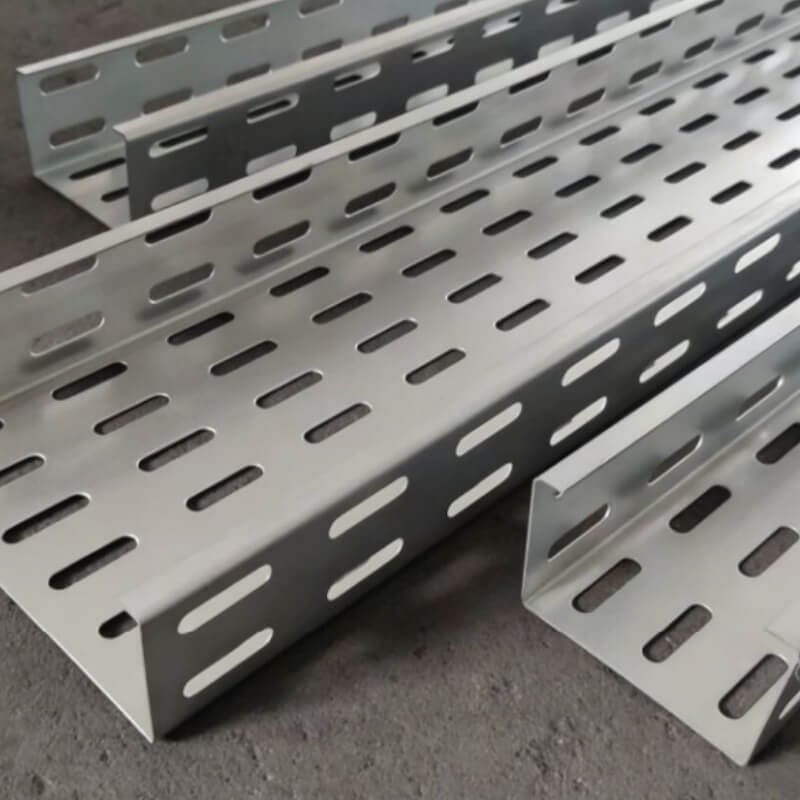
Perforated cable trays feature a rigid steel plate body with regularly arranged ventilation holes on the base and side rails. The integral bending structure provides excellent overall rigidity and stable load-bearing performance. We supply light, medium, and heavy-duty perforated trays that can withstand heavy cable stacking and long-term static pressure, making them suitable for laying thick power cables, multi-layer cables, and long-span wiring scenarios. The reinforced side rail design effectively prevents deformation during installation and daily operation.
Wire mesh cable trays or cable basket trays adopt a fully welded grid structure with lightweight and flexible features. The hollow mesh design greatly reduces the overall weight of the tray, allowing for quick manual cutting and on-site bending without professional tools. However, compared with perforated trays, wire mesh trays have weaker structural stability and lower load capacity. They are mostly applicable for light-load cabling, such as weak current cables, network cables, and communication wiring, and are not recommended for heavy power cable layout or long-distance spanning installation.

2. Heat Dissipation & Environmental Adaptability
Both tray types support natural ventilation, but their heat dissipation effects and environmental adaptability vary obviously. Winwin Perforated cable trays adopt orderly hole layout design, which balances structural strength and air circulation. They can continuously dissipate heat generated by high-current power cables, avoiding excessive temperature accumulation and ensuring safe and stable operation of power systems for a long time. Equipped with multiple surface treatments including hot-dip galvanized (HDG), pre-galvanized, stainless steel, and powder coating, perforated trays adapt to humid, coastal, and slightly corrosive industrial environments.
Winwin Wire mesh cable trays or cable basket tray have an all-round hollow structure with more sufficient air permeability and faster heat dissipation for light cabling. Their lightweight structure brings great convenience for ceiling concealed wiring and complex pipe layout. Nevertheless, the welded mesh structure is more susceptible to oxidation and corrosion in harsh environments. Therefore, wire mesh trays are more suitable for dry indoor environments such as office buildings, clean rooms, and ordinary commercial spaces, rather than heavy industrial or outdoor corrosive scenarios.
3. Project Application & Cost Analysis
In terms of engineering application scenarios, perforated cable trays are the preferred solution for industrial and heavy-duty projects, including factory production workshops, power plants, petrochemical plants, large logistics parks, corrosion resistant cable tray for coastal project,and outdoor trunk industrial wiring projects. With complete supporting accessories such as elbows, tees, crosses, risers, and reducers, they can form a standardized and unified cable routing system, which is convenient for later cable inspection, maintenance, and expansion.
Wire mesh cable trays are more suitable for civil and light commercial projects, such as office buildings, shopping malls, residential ceilings, and data center weak current wiring. Their biggest advantages are low unit weight, flexible installation, and short construction cycle, which can effectively save construction time and labor costs. However, for large-scale power engineering projects with high load requirements, the comprehensive cost of replacing and maintaining wire mesh trays in the later stage will be higher than that of perforated trays.
Conclusion
Choose perforated cable trays if you need heavy load capacity, strong structural stability, harsh environment resistance, and long-term industrial power cabling solutions. Choose wire mesh cable trays for light-duty weak current wiring, budget-friendly civil projects, and flexible ceiling wiring scenarios. Winwin Group provides full-series customized cable tray solutions with multiple surface treatments and complete supporting accessories to meet diversified global engineering standards.
Published by Fujian Winwin Group | UL/cUL CE & NEMA Certified Cable Management Manufacturer
SEO Core Keywords
Primary Keywords
Perforated Cable Tray, Wire Mesh Cable Tray, Industrial Cable Tray, Cable Management System
Secondary Keywords
HDG perforated cable tray, stainless steel wire mesh tray, pre-galvanized cable tray, heavy duty cable tray, data center cable tray, IEC 61537 cable tray
Long-tail Keywords
Perforated vs wire mesh cable tray difference, best cable tray for industrial wiring, heat ventilated cable tray for power plant, corrosion resistant cable tray for coastal project
Brand Keywords
Winwin perforated cable tray, Winwin wire mesh cable tray, Winwin industrial cable management system


 Send Email
 WhatsApp