
1. Types of Cable Trays That Require Earthing (per GB 50303-2015)
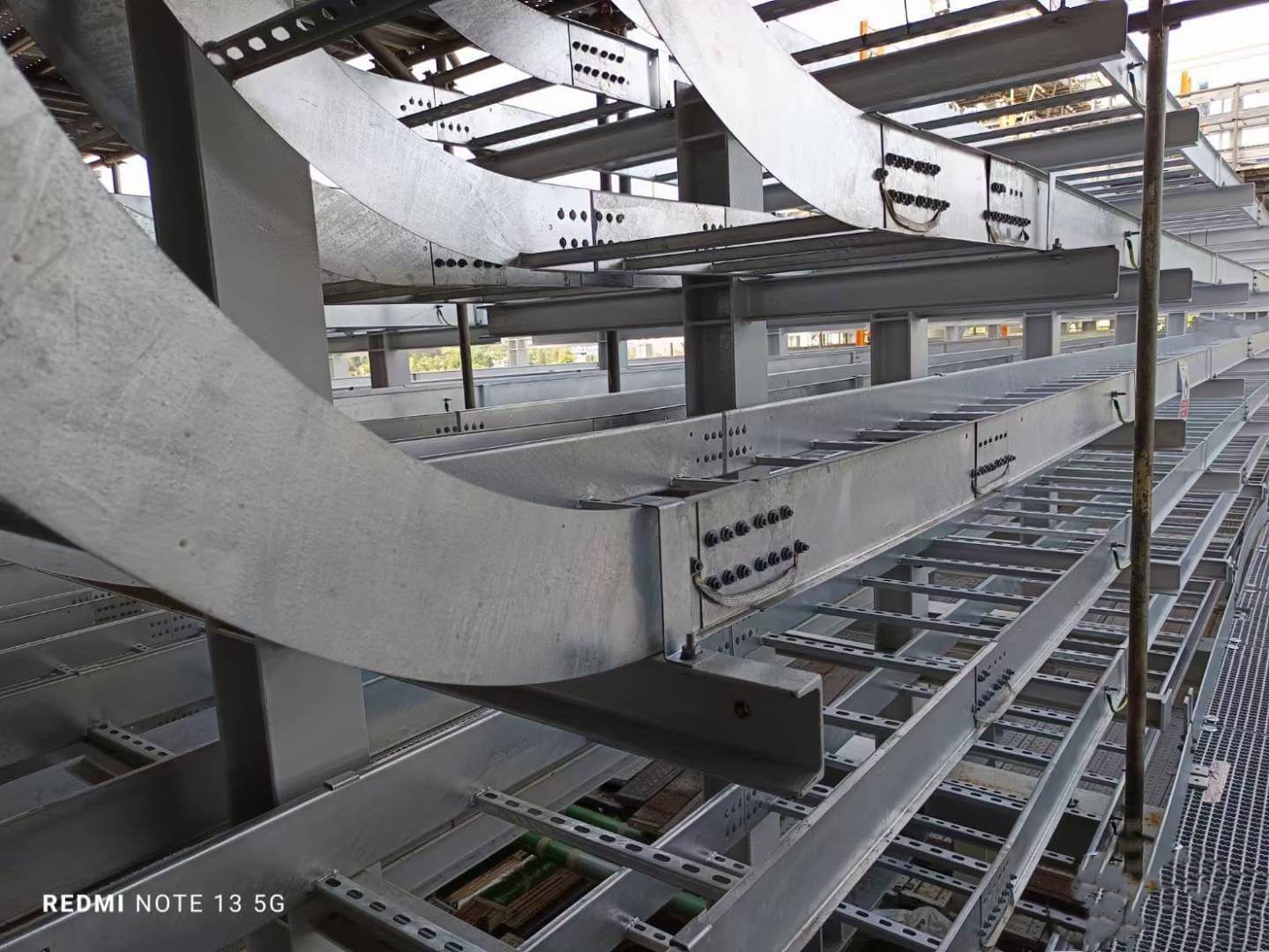
All Metal Cable Trays Are Mandated to Be Earthed
Trays Requiring Jumper Earthing Between Segments
• Powder-coated / fire-resistant painted steel cable trays
• Uncoated raw steel cable trays
Surface insulating coatings on these trays break electrical continuity. Copper earthing jumpers must be fitted across both ends of every connection joint to maintain continuous electrical conductivity along the entire tray run.
Galvanised Steel Cable Trays (Conditional Exemption for Segment Jumpers)
Hot-dipped galvanised and electro-galvanised trays rely on zinc coating for conductivity. Jumpers can be omitted only if each joint is secured with two sets of anti-loosening bolts and spring lock washers to guarantee full metal-to-metal contact. If anti-loosening fittings are missing, earthing jumpers are still required.
All matching metal accessories shall form part of the earthing circuit, including ladder trays, perforated cable trays, solid trunking, elbows, tees, reducers, metal support hangers and metal conduit outlets. The two terminal ends of every tray run must connect to the building’s main PE earthing busbar. For tray runs exceeding 30 metres in total length, additional earthing connection points shall be installed every 20 to 30 metres.
Non-Metal Cable Trays (FRP / Polymer Plastic)
Non-conductive tray bodies do not require direct earthing by default, split into two application scenarios:
1. General low-voltage power and weak current projects: No earthing required.
2. Explosion-proof industrial zones, high-voltage areas and data centres with heavy electromagnetic interference: A full-length galvanised flat steel earthing strip shall be laid inside the tray and linked to the building PE system to replicate the earthing function of metal trays.
Trays Exempt from Earthing
Fully non-metallic trays without internal metal liners, deployed in non-explosive, low-static and low-electromagnetic-interference environments, are exempt from mandatory earthing as per industry standards.
2. Standard Cross-Section Sizes of Earthing Wires (Copper Green-Yellow Flexible Cable / Copper Braided Strap, Minimum Compliance Sizes)
Jumpers for Standard Straight Tray Joints
The minimum regulatory cross-section is 4 mm² multi-strand flexible copper wire or copper braided strap, the most widely adopted specification for civil and standard factory projects.
For fire safety, explosion-proof and high-voltage sites, 6 mm² is commonly specified for enhanced conductive performance.
Larger Cross-Sections for Special Installation Points
1. Expansion joints, settlement joints and hinged expansion segments: Minimum 16 mm² copper braided flexible strap, as thin wires risk breakage from frequent thermal expansion and contraction of trays.
2. Main earthing conductors connecting full tray runs to the building PE busbar:
◦ Total cross-section of all cables inside the tray ≤ 16 mm²: Main PE conductor ≥ 4 mm²
◦ Total cable cross-section between 16 mm² and 35 mm²: Main PE conductor ≥ 16 mm²
◦ Total cable cross-section over 35 mm²: Main PE conductor shall be no less than half the total cable cross-section; 25 mm² and 35 mm² green-yellow copper cables are standard for heavy industrial high-current applications.
Galvanised Flat Steel Earthing Strip for Non-Metal Trays
The minimum specification is 40×4 mm galvanised flat steel (160 mm² cross-sectional area), laid continuously along the tray length and connected to the site earthing grid.
Quick On-Site Selection Reference for Engineering Projects
1. Joint jumpers for powder-coated / stainless steel trays: 4 mm² copper braided earthing strap (universal standard)
2. Joint jumpers for chemical plants, explosion-proof zones and data centres: 6 mm²
3. Expansion & settlement joint flexible jumpers: 16 mm²
4. Main earthing cables linking tray systems to building PE busbars: 16 / 25 / 35 mm², selected based on total load cable cross-section inside trays


 Send Email
 WhatsApp